

Wilhelm Lehmbrucks „Frauenbüste (Büste Frau L.)“ — Paris um 1910
“Sculpture, like every art, is the highest expression of its time.”
— Wilhelm Lehmbruck
Wilhelm Lehmbruck’s “Frauenbüste (Büste Frau L.)” is an outstanding work of art in many respects. Modelled after Lehmbruck’s wife Anita, the bust belongs to the extremely rare sculptures in white marble executed by Lehmbruck himself. In this version, the artist’s quiet conception of the human figure is combined with the particular effect of the material: the polished, subtly shimmering marble enhances the delicate restraint of the figure and gives it an almost withdrawn presence.
Further information on the artist’s life and work can be found in the biography of Wilhelm Lehmbruck.
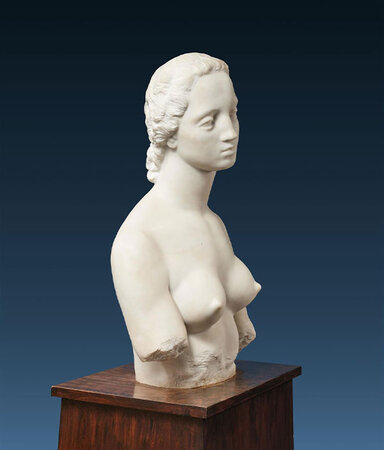
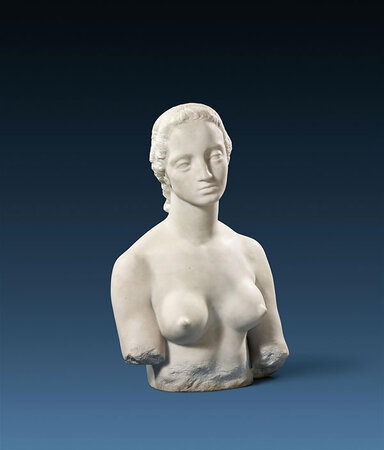
The work also possesses an exceptional provenance. It comes from the collection of the renowned Cologne industrialist, patron and collector Hermann Hertz (1856–1925), who acquired the “Frauenbüste (Büste Frau L.)” from the Sonderbund exhibition in Cologne in 1912. The work remained in the possession of the Hertz family for more than a century before the fourth generation of descendants entrusted the bust to Kunsthaus Lempertz.
The marble version was confirmed as an autograph execution by Dietrich Schubert, the author of the catalogue raisonné, and included in the catalogue under the number WVZ 50C. The sculpture thus combines artistic quality, museum-level significance and a provenance of rare continuity.
Paris 1910: Lehmbruck’s artistic new beginning
The “Frauenbüste (Büste Frau L.)” belongs to Wilhelm Lehmbruck’s important sculptural works from the period around 1910. In April of that year, the artist moved with his family from Düsseldorf to Paris. This step marked an artistic new beginning. Lehmbruck sought to distance himself from a form of sculpture still strongly bound to the academic tradition of the 19th century and opened himself to the impulses of international modernism.
In Paris, Lehmbruck quickly came into contact with new artistic positions. He established connections with Alexander Archipenko, became familiar with the female nudes of Aristide Maillol and engaged intensely with Auguste Rodin’s conception of the sculptural figure. These encounters did not lead to a mere adoption of foreign forms, but to the development of a language entirely his own: Lehmbruck’s figures became elongated, quieter, more spiritualised. The body no longer appears as a purely anatomical motif, but as an expression of inner concentration.
Shortly after his arrival in Paris, Lehmbruck created the well-known “Große Stehende” (WVZ 51), which was met with great acclaim at the Paris Salon. During the same period he produced several torsos, among them the “Frauenbüste (Büste Frau L.)”, which he had cast in bronze and in cement-bound cast stone. The marble version occupies a special position within this group of works.
The quiet power of marble
With a slight but decisive alteration to the inclination of the head and the direction of the gaze, Lehmbruck also executed the “Frauenbüste (Büste Frau L.)” in brilliant white marble, a material he used only rarely. This version reveals the sensitivity of his sculptural means with particular clarity.
In contrast to many of the female sculptures created before 1910, the figure is not conceived in terms of outward beauty or representative pose. The torso is reduced, the arms end in stumps of unequal length, and the head is markedly inclined. The gaze is directed inward. Everything about this sculpture seems oriented toward concentration, stillness and inner movement.
The figure’s delicate, restrained sense of movement is further heightened by the marble. The material removes any sense of heaviness from the body without dematerialising it. The sculpture remains physically present and at the same time appears sensitive, fragile and spiritually collected. This is precisely where its modernity lies: Lehmbruck renounces pathos and dramatic gesture. He creates a figure whose expression arises from measure, proportion and inwardness.
The “Frauenbüste (Büste Frau L.)” is therefore among those works in which Lehmbruck decisively renewed sculpture in the early 20th century. It is not a monumental statement, but an image of quiet inwardness.
The 1912 Sonderbund Exhibition in Cologne
A central moment in the history of the bust is the 1912 Sonderbund Exhibition in Cologne. It ranks among the most important exhibitions of European modernism before the First World War. Around 650 works by 153 international artists were shown in the exhibition halls at the Aachener Tor. Among the artists represented were Vincent van Gogh, Paul Gauguin, Edvard Munch, Pablo Picasso and Wassily Kandinsky.
Wilhelm Lehmbruck was represented at the Sonderbund exhibition by five of his most recent sculptures and two paintings. In addition to the “Frauenbüste (Büste Frau L.)”, he showed the “Große Kniende”, dated 1911, the bronze “Weiblicher Torso”, the “Lebensgroßer Torso” and the cast-stone “Junges Weib”. The works were displayed in rooms 5, 10 and 21 of the exhibition.
The Sonderbund exhibition made clear the special position Lehmbruck occupied within modernism. While other artists turned to strong expressive intensification or formal fragmentation, Lehmbruck developed a quiet, concentrated and profoundly human visual language. His figures do not exert their effect through dramatic movement, but through inner tension. It was precisely this combination of classical formal discipline and modern sensibility that made his sculptures visible within the European avant-garde.
Lehmbruck was aware of the significance of this exhibition. In July 1912, he travelled from Paris to Cologne. His presence in the context of the exhibition is documented by a meeting with Erich Heckel and Ernst Ludwig Kirchner. It is also possible that he encountered there the Cologne collector and patron Hermann Hertz, who acquired the marble bust directly from the exhibition.
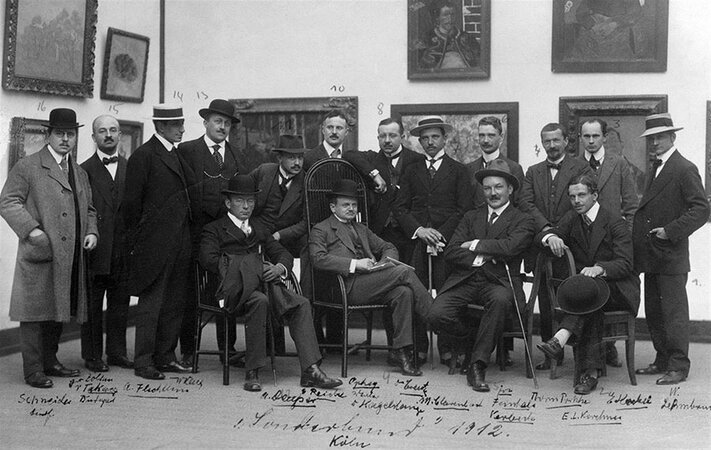
Far right: Wilhelm Lehmbruck, next to him Erich Heckel, Ernst Ludwig Kirchner, Jan Thorn Prikker.
Seated in the center: Alfred Hagelstange.
Third from the left: Alfred Flechtheim.
Rhineland Photographic Archive Cologne, rba_107512.
Hermann Hertz: collector, patron and co-founder of the Sonderbund
Hermann Hertz and his family belonged to Cologne’s educated Jewish bourgeoisie. Born in Hildesheim in 1856, Hertz moved to Cologne in 1878/79. Together with Max Rosenberg, he founded a factory and trading company for corsetry in 1882. The company employed around 600 people and exported to France, England and Switzerland.
Hertz developed an early interest in modern art. He was active in the association “Die Gilde” and in the “Westdeutscher Bund für angewandte Kunst”, which understood itself as an association of patrons. As an art patron, Hermann Hertz was among the co-founders and supporters of the Sonderbund exhibition. He helped shape its concept and was appointed its treasurer.
In the discussions surrounding the participation of contemporary artists who were still controversial at the time, Hertz represented the progressive camp together with Alfred Hagelstange, director of the Wallraf-Richartz Museum, Richard Reiche of Wuppertal and Alfred Flechtheim. His acquisition of the marble bust “Frauenbüste (Büste Frau L.)”, exhibited under number 600 in room 21, shows how early Hertz recognised the significance of Lehmbruck’s work.
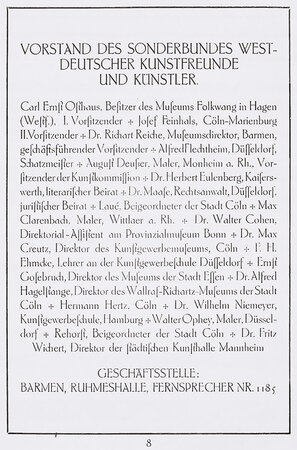
Association of West German Art Lovers and Artists in Cologne, 1912. Illustrated catalogue – listing of “Hermann Hertz, Cologne” as a member of the Sonderbund board.
The purchase was not an isolated case. Over time, Hermann Hertz built up an extensive collection that included works by Eugène Boudin, Paula Modersohn-Becker, George Minne, Ernst Barlach, George Grosz, Max Slevogt, Max Liebermann, Ernst Ludwig Kirchner and Maurice de Vlaminck. His home was at once a private residence, a place for the display of his collection and a site of exchange for modern art in the Rhineland.
A provenance spanning four generations
After Hermann Hertz’s death in 1925, his son Walter Hertz (1895–1986) inherited the marble bust. With the seizure of power by the National Socialists, the situation of the family changed dramatically. Walter Hertz fled with his wife Dorothea and their daughter Ursula to the Netherlands in 1936 and later to Brussels in 1940.
Although Belgium was occupied by the National Socialists, the family managed to survive in hiding. The marble bust “Frauenbüste (Büste Frau L.)” was also preserved despite these adverse circumstances. The history of the work is thus not only a history of artistic modernity, but also one of flight, danger of loss and preservation.
In 1986, the bust was at Kunsthaus Lempertz for the first time in order to be examined in connection with the catalogue raisonné then being prepared. The expert and author Dietrich Schubert was able to inspect the work for the first time and included it in the catalogue under the number 50C.
The fact that the “Frauenbüste (Büste Frau L.)” remained in the same family for more than a century gives its provenance an exceptional continuity. It connects Lehmbruck’s Parisian new beginning, the Sonderbund exhibition of 1912, the patronage of Cologne’s Jewish bourgeoisie and the history of a collection preserved across generations.
A highlight of 20th-century German sculpture
The “Frauenbüste (Büste Frau L.)” is one of the early works in which Wilhelm Lehmbruck found his new sculptural language. The slightly inclined head, the inward-directed gaze and the delicate reduction of the body make it one of the first sculptures of that inner concentration which would become so characteristic of Lehmbruck’s work.
Inspired by Maillol, shaped by Rodin and further developed in the environment of the Parisian avant-garde, Lehmbruck arrived around 1910 at a form of sculpture that aims not at outward effect, but at spiritual presence. With its rare execution in marble, its inclusion in the catalogue raisonné and its provenance from the collection of Hermann Hertz, the “Frauenbüste (Büste Frau L.)” represents a highlight of German sculpture of the early 20th century.
It is a work of exceptional stillness — and precisely for that reason, of profound modernity.
Discover the “Female Bust (Bust L.)” in the Lempertz catalog.
Auction Dates
Auction 1291 - Evening Sale - Contemporary Art
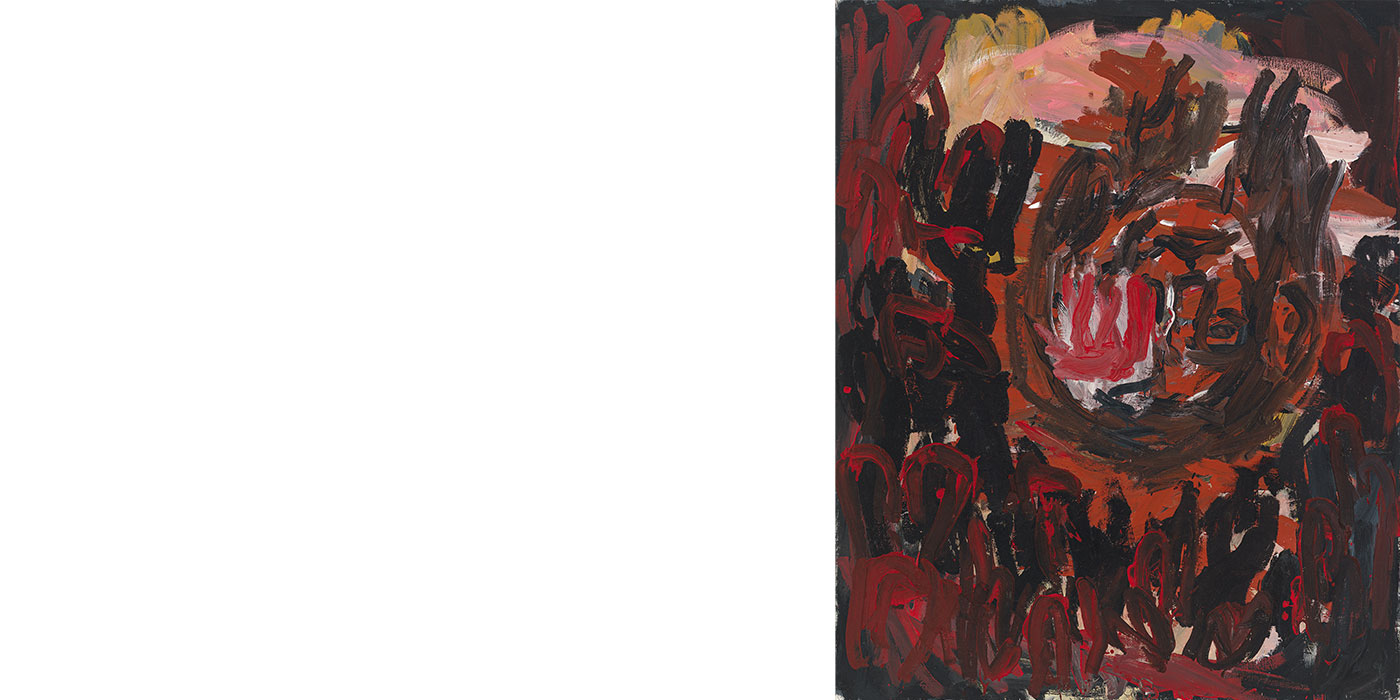
Auction
Friday 5 June
6 pm Lot 1 – 55
Preview
Saturday, May 30, 10 am – 4 pm
Sunday, May 31, 11 am – 4 pm
Thursday 4 June, 11 am – 4 pm
Matinée
Saturday, May 30, from 11 am
Dr. Daniel Zamani (Museum Frieder Burda) in conversation with
Isabel Apiarius-Hanstein on Yoshitomo Nara, at 12 PM
Introduction to the sculpture “Frauenbüste (Büste Frau L.)”
by Wilhelm Lehmbruck
_______________________________________________________
MUNICH
A selection
St.-Anna-Platz 3, 80538 Munich
Monday, May 4 – Wednesday, May 6, 10 am – 5 pm
_______________________________________________________
BERLIN
A selection
Poststr. 22, 10178 Berlin-Mitte
Monday, May 11 / Tuesday, May 12, 10 am – 5 pm
After-work reception
Monday, May 11, from 5 pm
Catalogue
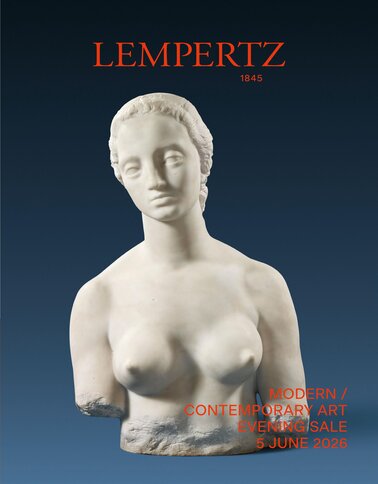
Auction 1291 - Evening Sale - Modern Art
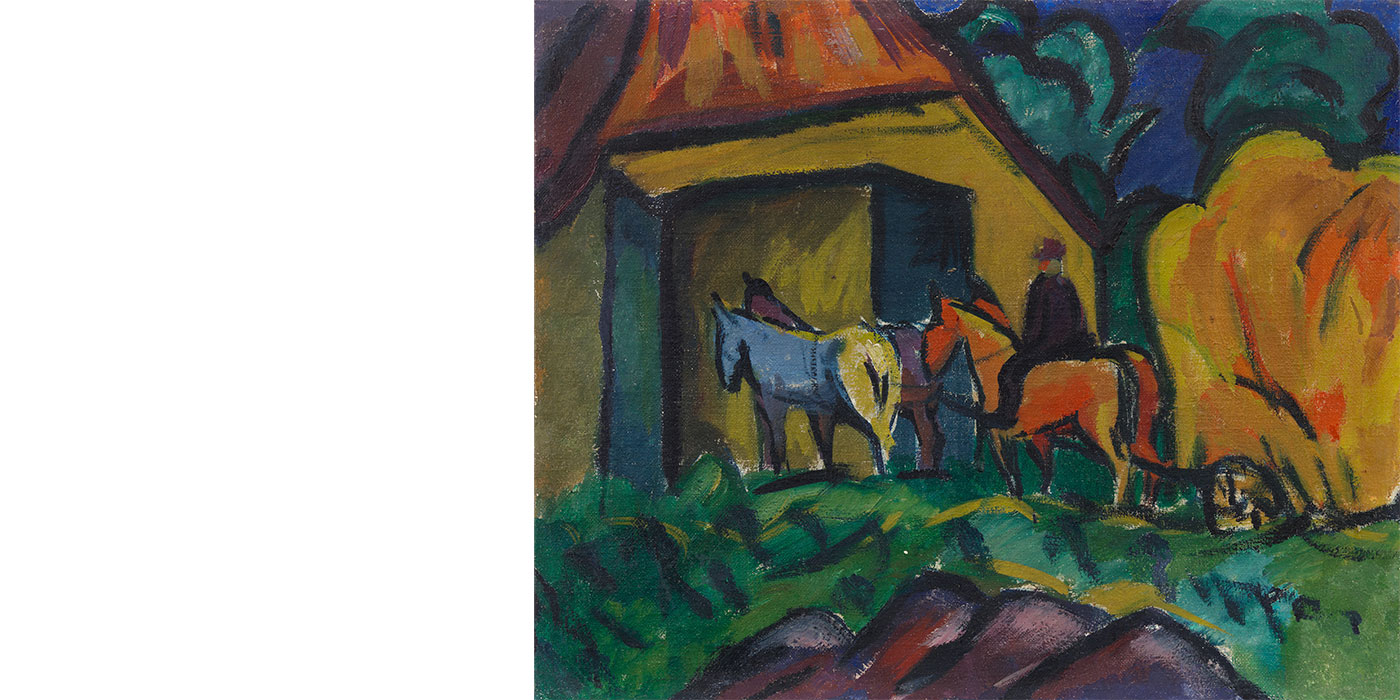
Auction
Friday 5 June
6 pm Lot 1 – 55
Preview
Saturday, May 30, 10 am – 4 pm
Sunday, May 31, 11 am – 4 pm
Thursday 4 June, 11 am – 4 pmt
Matinée
Saturday, May 30, from 11 am
Dr. Daniel Zamani (Museum Frieder Burda) in conversation with
Isabel Apiarius-Hanstein on Yoshitomo Nara, at 12 PM
Introduction to the sculpture “Frauenbüste (Büste Frau L.)”
by Wilhelm Lehmbruck
_______________________________________________________
MUNICH
A selection
St.-Anna-Platz 3, 80538 Munich
Monday, May 4 – Wednesday, May 6, 10 am – 5 pm
_______________________________________________________
BERLIN
A selection
Poststr. 22, 10178 Berlin-Mitte
Monday, May 11 / Tuesday, May 12, 10 am – 5 pm
After-work reception
Monday, May 11, from 5 pm
Catalogue