

“You can live with art, but you have to love it too!”
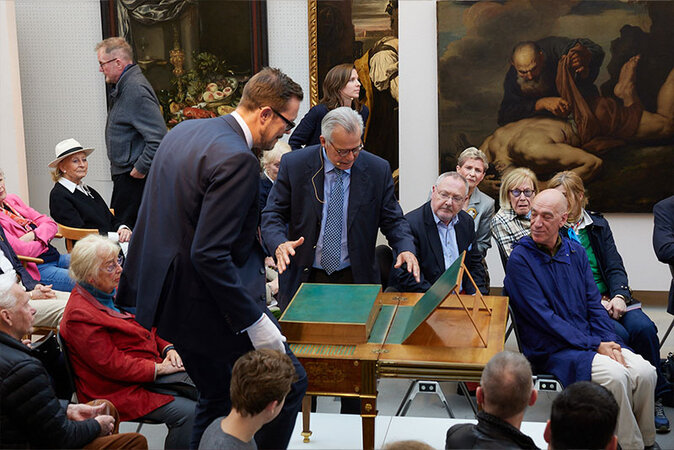
Dr. Ulrich Leben has conducted extensive research on the Palais Beauharnais, the residence of the German Ambassador in Paris. Prior to an auction of exquisite Roentgen furniture, he spoke at Lempertz about living amidst classical furnishings.
The value of the interior was roughly equivalent to that of a palace in the most prestigious areas of Paris. The quality of the interior design of the Hôtel Beauharnais, as commissioned by Eugène de Beauharnais, is almost impossible to convey to today’s eye, which is accustomed to mass-produced furniture. Even after his departure from Paris for Munich—where he was married to Amalie Auguste of Bavaria—Napoleon’s stepson had several pieces from this exquisite interior shipped after him, until he began to jeopardize the value of the emptying Parisian residence.
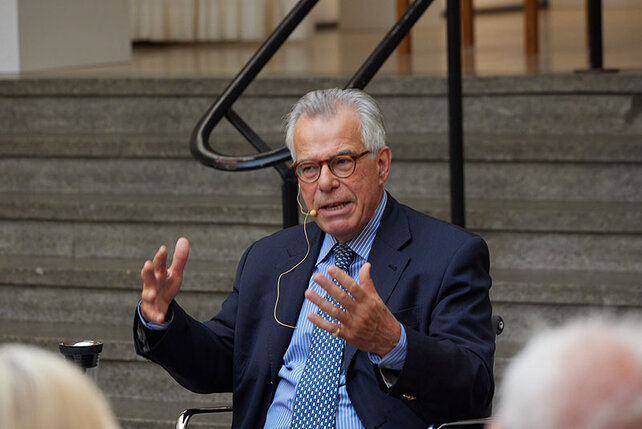
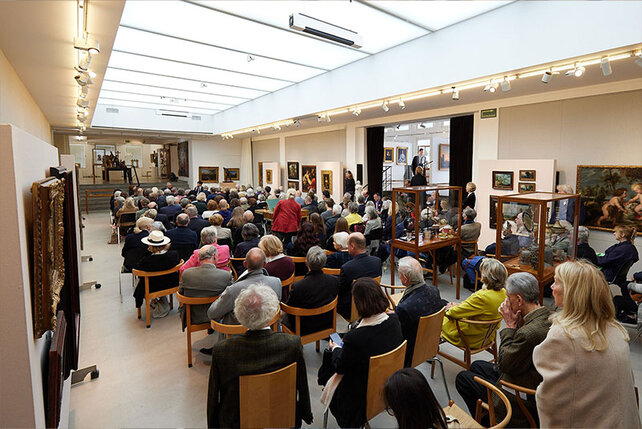
The fact that these circumstances are so astonishing to us, who are accustomed to industrial products as furnishings, is likely also due to the fact that we have forgotten how to appreciate the treasures of finest craftsmanship. This was vividly illustrated by the art historian Dr Ulrich Leben at the matinee at the Kunsthaus Lempertz. He has studied the Hôtel Beauharnais, which now belongs to the German Embassy, in great detail as part of his professional work. For him, however, appreciating such furniture also means knowing how to use and care for it. Thus, the finest examples of 18th-century craftsmanship continue to bring joy to those who use them in the 21st century.
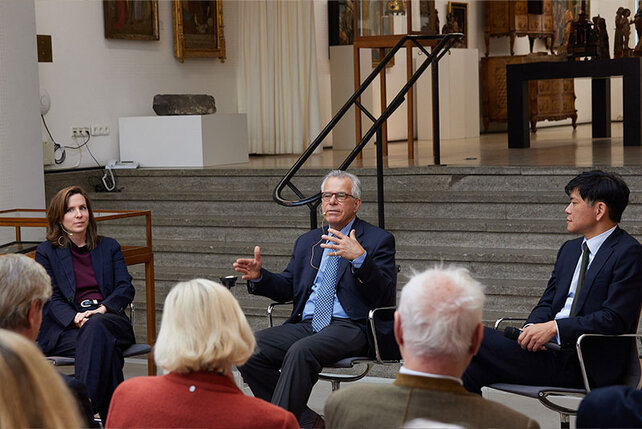
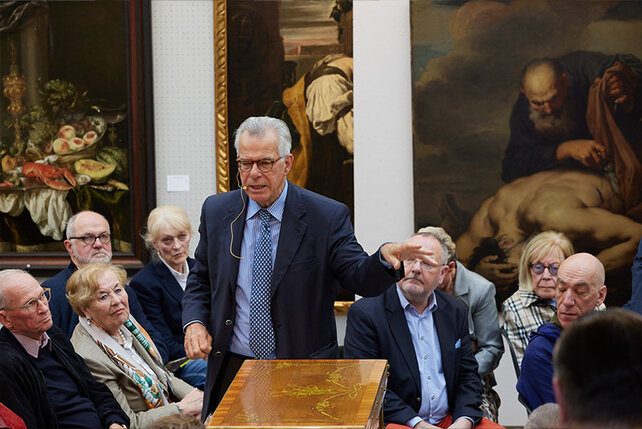
If you sit on furniture in the manner intended for high-quality seating, your shoes may leave black marks on white chair legs, but these are easy to remove. Old seating furniture remains comfortable even today, as long as you actually sit on it. The surface of a historic table does not accept everything one places upon it, nor does it appreciate a modern quick polish. However, if it is properly cared for, its visual and tactile qualities provide a joy incomparable to that of other furniture. Ulrich Leben’s observations, made directly at a museum-quality convertible table by David Röntgen, allow us to witness just how rewarding such behaviour is and how it pays off in the enjoyment of these historical treasures.
Yet it is not merely this delight in the supreme achievements of furniture art that Ulrich Leben – who studied art history in Bonn, Berlin, and Paris, and moreover completed an apprenticeship as a cabinetmaker ‒ values in these historical pieces. Even for icons of modern design such as the furniture of Charles Eames or the Bauhaus, there lies an origin in craftsmanship, without an understanding of which any grasp of modern design remains partial, at best. The Bauhaus therefore placed great emphasis on a precise knowledge of the materials and their processing. Brought to perfection, this artisanal approach to material is evident in the furniture of David Röntgen as well as in that of his father, Abraham. Such achievements, which are almost impossible to match today, may therefore be regarded as classic in the highest sense, as points of reference of enduring significance.
The auction on 20th May provided striking evidence of the value attributed to outstanding works. With a final price of just over €165,000, David Röntgen’s convertible table exceeded expectations. Further evidence of the esteem in which such outstanding pieces are held was provided by the sale of an architect’s table by Abraham Röntgen. With a result of over €100,000, it too sold above its estimate.