Women’s power at the Berlin Porcelain Manufactory
The history of European porcelain, from its rediscovery at the beginning of the 18th century through to the 20th century, was long shaped by men.
In Meissen, the alchemist Johann Friedrich Böttger and the natural scientist Ehrenfried Walther von Tschirnhaus, working on behalf of Augustus the Strong, uncovered the secret of porcelain production and thus laid the foundation for Europe’s first manufactory. From 1710 onward, designers such as Johann Gottlieb Kirchner and Johann Joachim Kändler created new models, which were refined by decorators like Johann Gregorius Höroldt using newly developed overglaze colors.
At the later porcelain manufactory foundations across 18th-century Europe, it was also almost exclusively men who defined the artistic direction in form design and painted decoration. Only in very rare cases were women allowed to take on painting tasks in the workshops—and then solely as executing artisans, not working from their own designs.
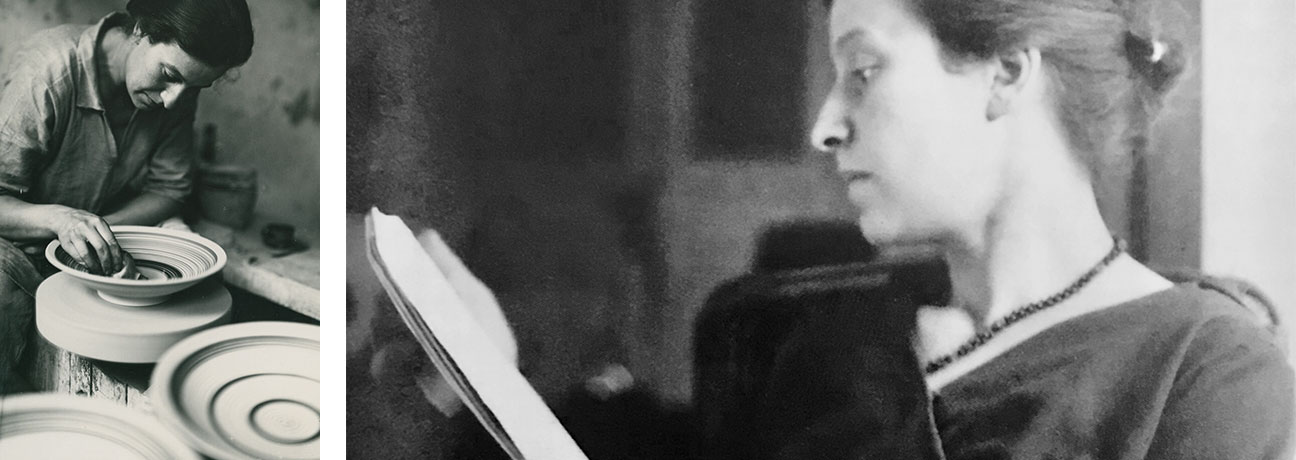
It was not until the late 19th century, in the wake of the Secession movements and the rise of Art Nouveau, that women in some manufactories began to attain positions in which they could realize their own artistic ideas in porcelain art. This initially occurred mainly in the fields of painting and ornamental design. At the Royal Porcelain Manufactory in Copenhagen, the two artists Effie Hegermann-Lindencrone and Fanny Garde were already designing contemporary porcelain models around 1900, featuring vegetal and marine reliefs combined with matching underglaze painting.
At roughly the same time, in September 1902, the model book of the Royal Porcelain Manufactory Berlin lists, under number 7119, a new plate “with openwork.” One hundred and thirty-nine years after its acquisition by King Frederick II, this marks the first model designed by a woman. It was created by Johanna Beckmann, who primarily worked at KPM as an ornamental painter and also achieved success outside the manufactory as a paper-cutting artist. (Just under a year later, two additional openwork plates based on her designs followed.)
In Germany, women were prohibited from formally studying art until well into the 20th century. Although private art schools offering professional training to women had existed since the late 1860s, such studies did not lead to academic degrees. It was only in 1908 that Prussia, as the first German state, opened its public art academies to women, and from 1919 onward, equal educational rights for both genders were formally established throughout Germany.
Even before that, women had been able to attend schools of applied arts under certain conditions. However, the egalitarian reform efforts in the training of female artists—simultaneously advanced across large parts of the German Empire—led to a significant increase in enrollment among aspiring women art students. In Berlin, the teaching institute of the Museum of Applied Arts, led by Bruno Paul from 1909 onward, became the first point of contact for this new generation of emerging female artists. In 1924, it merged with the long-established academy to form the United State Schools for Fine and Applied Arts, further elevating the status of applied art, whose production was taught in a practical manner within dedicated workshops.
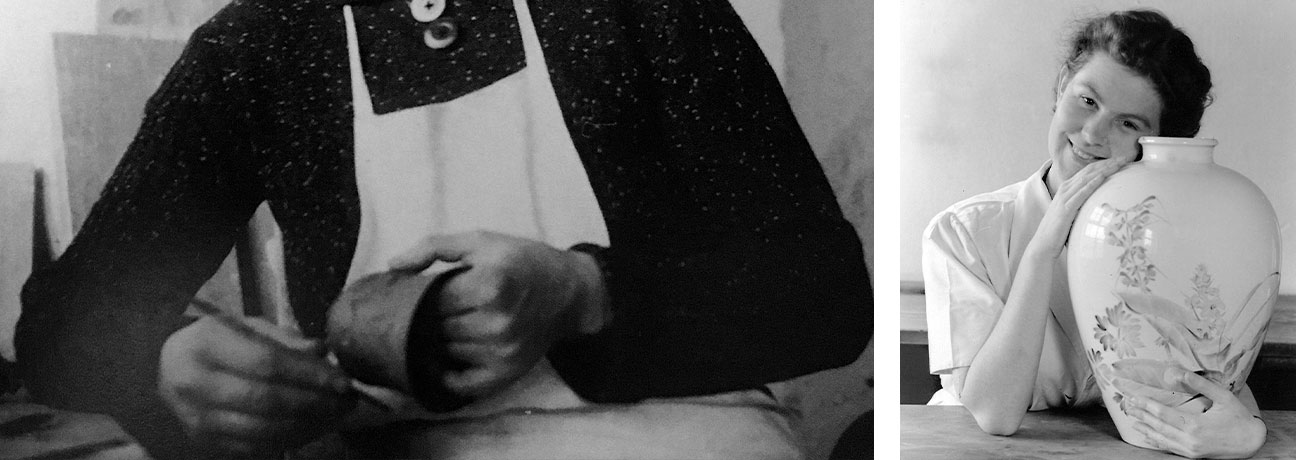
The newly founded Bauhaus in Weimar was also attended by nearly half women in its early years. However, this proportion declined after its relocation to Dessau in 1925, so that between 1919 and 1933, women made up roughly one third of Bauhaus students overall.
At the Berlin Porcelain Manufactory—which, following the end of the German Empire and the establishment of the Weimar Republic, officially bore the title State Porcelain Manufactory Berlin, yet continued to promote itself with its scepter, imperial orb, and KPM mark—this spirit of female advancement soon became evident.
Even during the First World War, director Theodor Schmuz-Baudiss, who in the 1910s repeatedly incurred the displeasure of the artistically conservative imperial couple, had already emerged as a supporter of the porcelain painter Gertrud Kant. Kant, a graduate of the Municipal School of Applied Arts and Crafts in Charlottenburg, created her own distinctive, imaginatively playful painted decorations for KPM between 1917 and around 1925. At the same time, from 1919 onward, she led the porcelain painting class at the School Reimann in Berlin-Schöneberg, an institute for art and applied arts founded in 1902 by Albert Reimann.
From 1925, under its new director Nicola Moufang, the Berlin manufactory worked very closely with Bruno Paul’s United State Schools for Fine and Applied Arts. This collaboration involved, on the one hand, the progressive segment of the school’s teaching staff—whose (exclusively male) members supplied models and painted decorations intended to meet the aesthetic demands of the new era. On the other hand, a so-called ceramic specialist class was established, where, under the direction of the ceramic artist and sculptor Otto Gothe, promising young talents were to be trained.
Although the surviving student lists of this class are incomplete, the proportion of women was high, and within just two years the first (female) successes became apparent. The young student Edith Alberti produced several highly modern vase and bowl designs (both form and decoration), which attracted considerable attention at major applied arts exhibitions in Monza and Leipzig in 1927/28. However, her private life plans prevented her from pursuing a further career after 1930.
Another attendee of the specialist class was the sculptor Judith Speer, who, at that time, designed several animal figures for KPM’s serial production, as did Sabine Lepsius Jr. The latter was the daughter of the artist couple Sabine Lepsius Sr. and Reinhold Lepsius, both prominent figures of the Berlin Secession period. In the 1930s, she also created decorative designs for the Nymphenburg Porcelain Manufactory.
From 1929 onward, Günther von Pechmann headed the manufactory and was confronted with major challenges brought about by the escalating global economic crisis. This caused large parts of the porcelain market, both at home and abroad, to collapse.
The economic as well as aesthetic solution was summarized under the slogan “porcelain for modern living”: easy-to-produce, simply designed yet artistically refined utility porcelain was intended—through functionality and largely ornament-free design—to attract new groups of buyers and win back former customers.
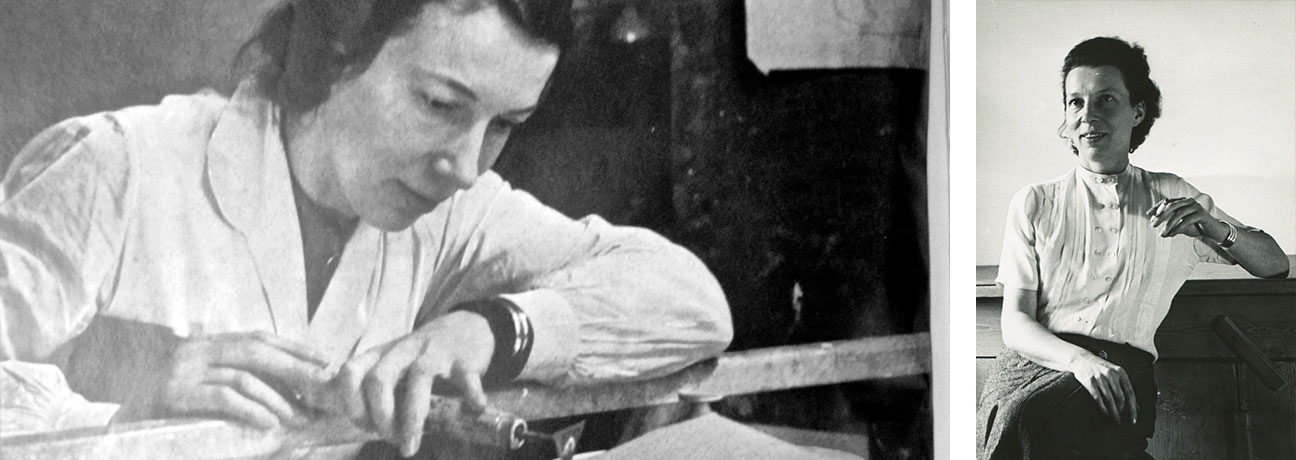
Two young ceramic artists ensured that the successful realization of modern porcelain ideals at KPM Berlin in the early 1930s became a reality through their groundbreaking designs: Marguerite Friedlaender and Trude Petri.
Friedlaender, ten years older, had been among the first Bauhaus students in 1919, training in the Dornburg ceramics workshops under master sculptor Gerhard Marcks. In 1925, she took over the ceramics class at the workshops of the city of Halle (Burg Giebichenstein School of Applied Arts), and the following year became one of the first women in Germany to successfully pass the master potter’s examination.
From autumn 1929 onward, the Berlin Porcelain Manufactory collaborated with the newly established porcelain class in Halle, where Friedlaender devised prototypes for new utility porcelain and produced them together with her students. These were then refined for series production in Berlin. Within just a few years, this led to the creation of design classics such as the Halle service (lots 339 and 340) and the corresponding range of vases. Until the National Socialists came to power in January 1933, this collaboration developed into perhaps the most successful joint project between a state-run enterprise and an art school in the history of porcelain. Friedlaender initially fled to the Netherlands and was later able to emigrate to the United States in 1940. At Pond Farm in California, she became one of the most influential ceramics teachers in the country.
A second stroke of luck for KPM, also in 1929, was the permanent appointment of Trude Petri as a form designer. Petri had begun her training in pottery in Hamburg in 1925 at the State Schools for Fine and Applied Arts, but moved to Berlin two years later. There, she attended the ceramic specialist class of KPM and the State Schools and carried out smaller commissions for the manufactory. In August 1929, her first model designs for three small flower vases were entered into the model book.
Initially, the 23-year-old focused, very much in keeping with the spirit of the time, on artistically transforming older forms from the chemical-technical department into modern utility porcelain. Yet in that same first year, she also produced her own designs for table services, vases, bowls, and other everyday objects (lots 341–344). With the Urbino model, developed in 1930/31 and continually expanded with numerous additional pieces, the young designer achieved an early design icon: the first all-white, rimless dinner service in the history of porcelain.
In the decades that followed, Petri created numerous other successful porcelain designs for KPM, all characterized by elegant simplicity combined with a refined sensibility of the time. After settling in Chicago in 1949, she continued to supply newly conceived models for services, vases, candlesticks, bowls, lamps, and more until 1968.
Another graduate of the ceramic specialist class, Else Möckel, would go on to exert the greatest influence on the painted decoration of the State Porcelain Manufactory Berlin in the 1930s. She had already studied at the teaching institute of the Museum of Applied Arts before 1924 and was later supported at the merged State Schools by Ernst Böhm, dean of the Department of Applied Arts. Böhm had many of his designs for the redesign of the cashier’s hall at the manufactory’s sales branch on Leipziger Straße executed by Möckel on porcelain panels.
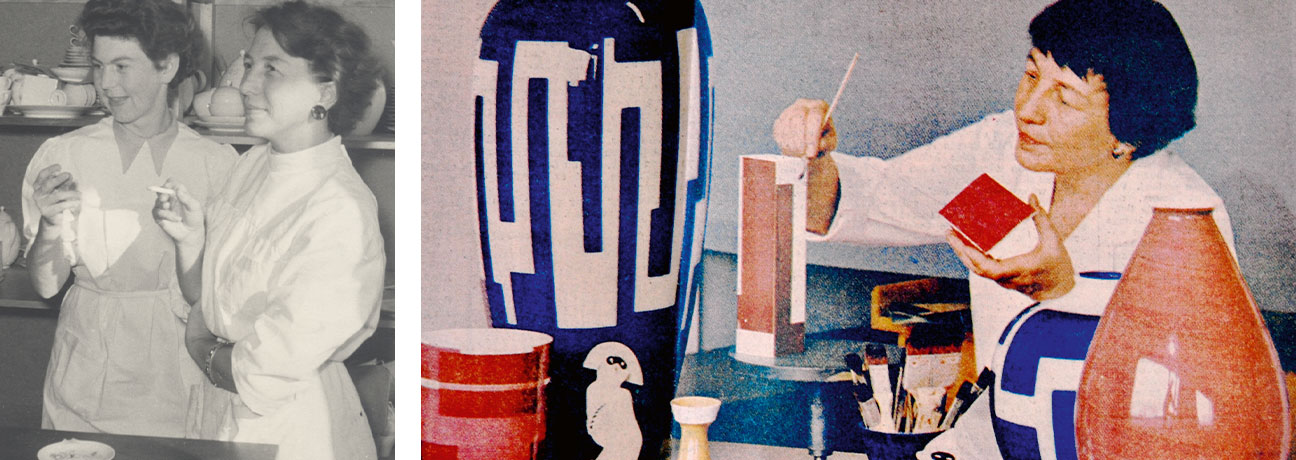
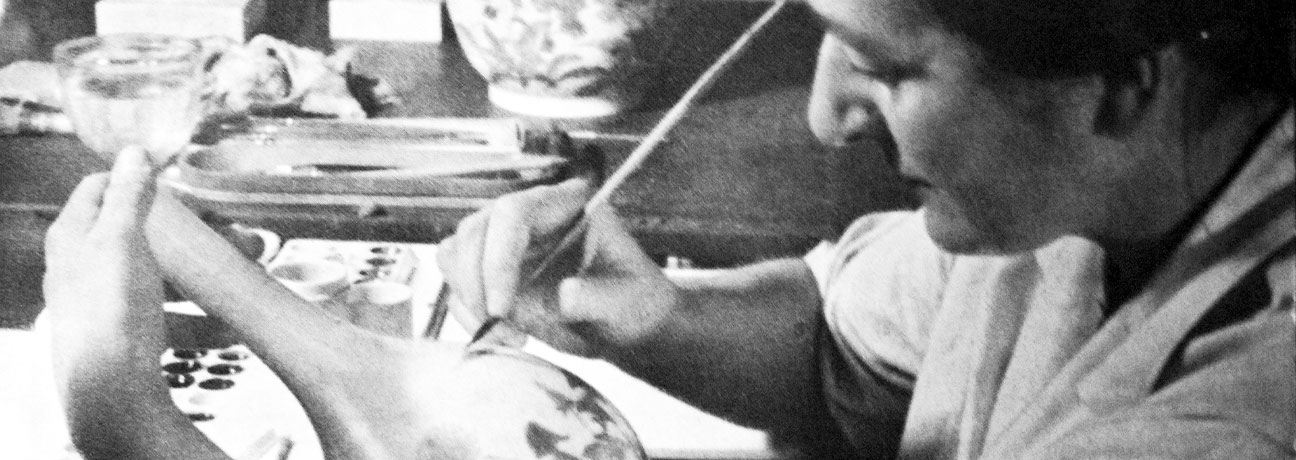
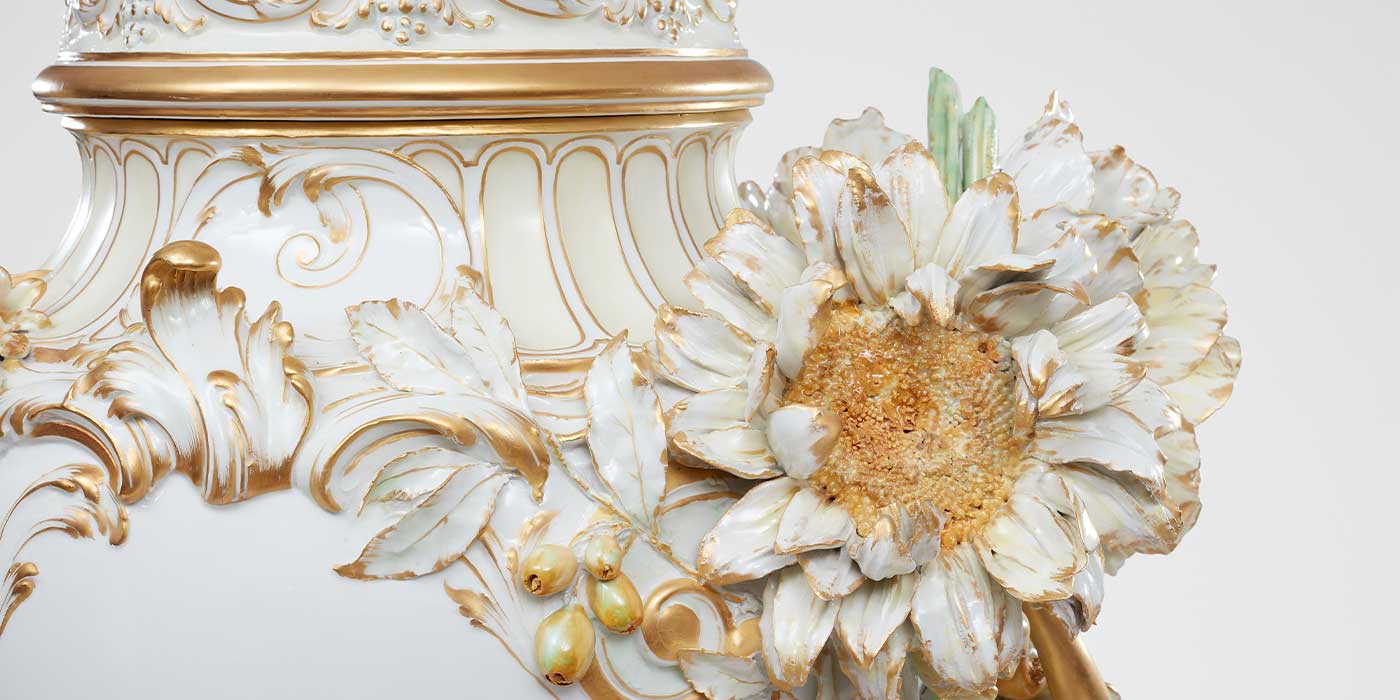
However, the young artist found her true calling over the course of the 1930s, when she carefully yet distinctively advanced the manufactory’s traditional flower painting in her own unique style, elevating it to new heights. Until the partial destruction of the manufactory grounds in November 1943, Möckel decorated numerous vases, bowls, and table services with her characteristic botanical designs. These were based on meticulous studies of nature, yet transformed natural forms into art through subtle stylization and the skillful omission of detail.
Möckel also passed on the philosophy and artistic execution of her floral and botanical painting to the next generation of porcelain designers, who naturally began their careers as painters. The two trainees Sigrid von Unruh (lots 342 and 347) and Luise-Charlotte Koch (lots 347 and 348) studied under her in the second half of the 1930s.
After the evacuation of the painting department to Karlovy Vary and the relocation to the external facility in Selb in 1945, von Unruh continued Möckel’s tradition of floral painting, selectively modifying it and developing her own distinctive style. From 1946 onward, von Unruh and Koch were the only contractually employed female designers at KPM in the field of decorative art. Both created numerous designs characteristic of their time, including both figurative and abstract works.
While narrative painting still frequently appeared on KPM porcelain in the 1950s, abstraction increasingly gained ground over time, particularly during the 1960s. Cobalt blue as well as geometric and repetitive patterns became especially popular, particularly following the widely celebrated 200th anniversary of the company in 1963.
The model forms, meanwhile, continued to be supplied predominantly by Trude Petri, Siegmund Schütz, and, from autumn 1952 onward, Hubert Griemert, a former associate of Marguerite Friedlaender at Burg Giebichenstein.
It remains to be hoped that KPM Berlin will continue—and increasingly expand—its support for female artists in the 21st century, enabling them to express their artistic ideas in both form and decoration, and thus offer the porcelain-loving public works of enduring beauty.
Auction Dates
Auction
Saturday 25 April 2026
11 am | Lot 1 – 250
2.30 pm | Lot 250 – 351
Preview
Opening Reception
Friday, 17 April | 6 pm
Saturday, 18 April | 11 am – 5 pm
Sunday, 19 April | 11 am – 5 pm
Monday, 20 April | 10 am – 5 pm
Tuesday, 21 April | 10 am – 5 pm
Wednesday, 22 April | 10 am – 5 pm
Thursday, 23 April | 10 am – 5 pm
Friday, 24 April | by appointment
Catalogue