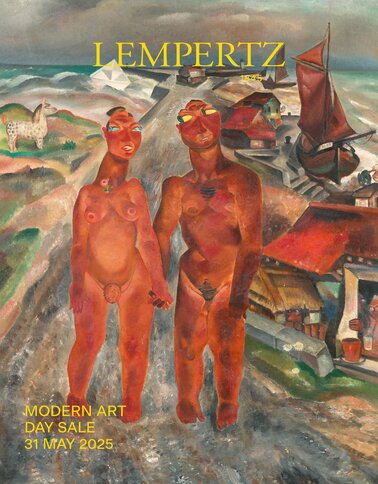
The Estate of Oskar Schlemmer
Following an agreement reached in court regarding the long legal battle over the estate of Bauhaus master Oskar Schlemmer (1888-1943), two central works by the artist are now coming up for auction at Lempertz. Finalised in December 2024, the court settlement regulates the allocation of numerous paintings, watercolours and drawings formerly owned by the artist’s widow, Tut Schlemmer. At the end of the proceedings, it was no longer only about 65 works (some of which were in storage at the Stuttgarter Staatsgalerie at that time) but the complete estate. Donations to selected museums are also part of the agreement.
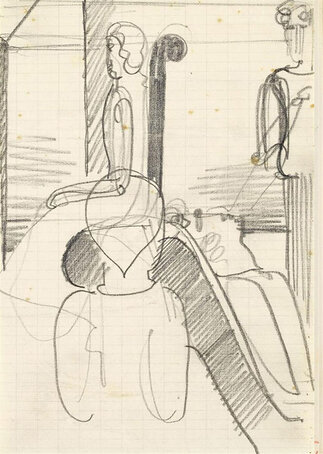
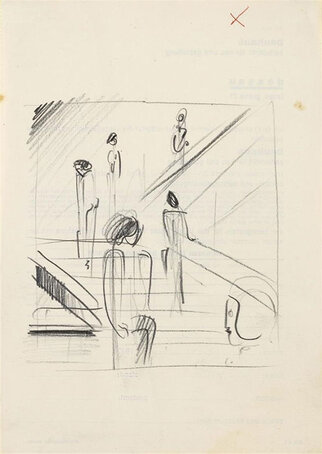
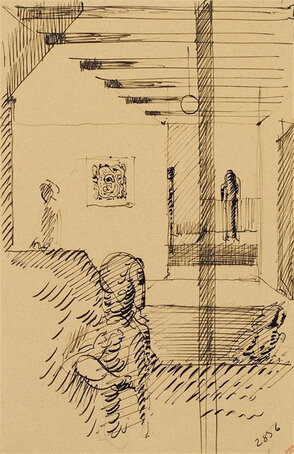
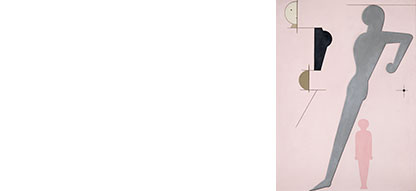
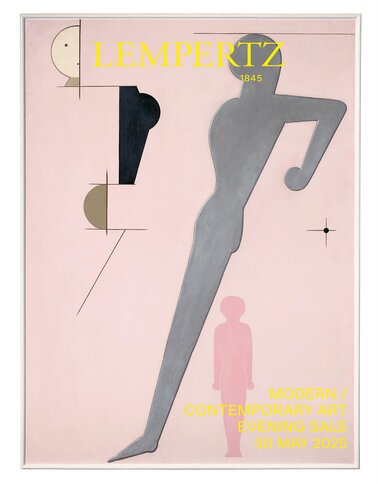
Kunsthaus Lempertz had already auctioned off the first work from the estate in November 2024: “Freiplastik G”, the most important sculpture from Schlemmer’s Bauhaus period. Now, at the auction at the end of May, 21 works from the Schlemmer estate will initially be put up for sale. The top two lots are the large-format “Komposition auf Rosa” and the “Sechs-Köpfe-Fries”, which belongs to the artist’s late work as a painter. These are joined by primarily early works on paper. Besides watercolours featuring characteristic heads and groups of diners arranged in perspective, the Schlemmer estate also includes a preliminary drawing for what may be Schlemmer’s best-known work, the painting “Bauhaustreppe” (Museum of Modern Art, New York). Kunsthaus Lempertz is pleased to be able to auction these works.
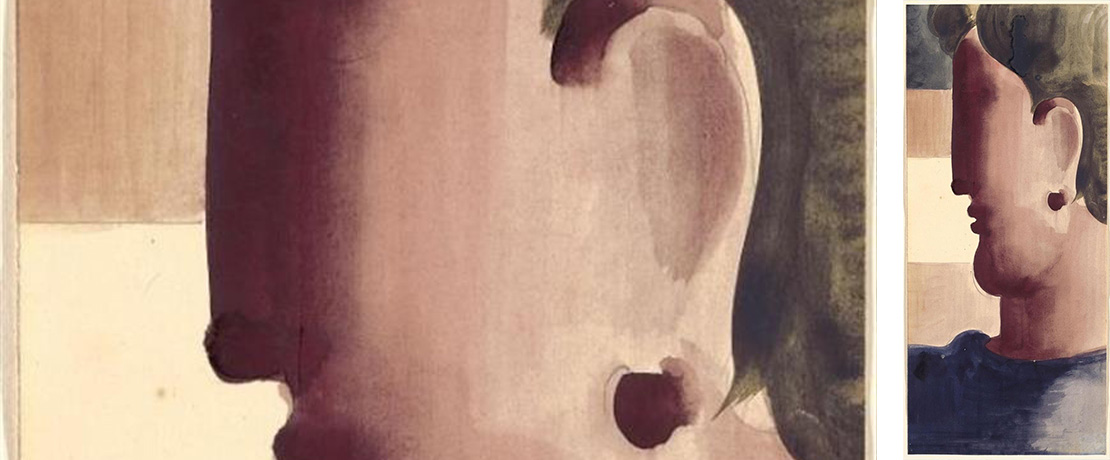
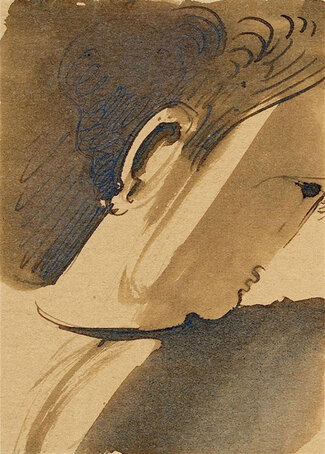
Oskar Schlemmer was at the pinnacle of his artistic career in 1932, when he created his best-known work, the “Bauhaustreppe” (Museum of Modern Art, New York) – in preparation for which he occupied himself paradigmatically with the human figure and its relationship to space. The watercolour “Großer Kopf im Profil” is also connected with this iconic work of art history. Composed in delightful harmonies of blue, pink, ochre and brown, this watercolour belongs to a group of works done in colour on paper in which Schlemmer circles around a theme and its primary motif. With pointed contrasts in value evoking a light source to the right, the artist has captured a male head whose dark silhouette is placed before the light stripes of the background to produce a striking effect. Schlemmer has masterfully developed the interplay of light and shadow, the material of the colours and their “blending” into the beige tone of the ivory paper. The decisive framing in pencil is also characteristic of the watercolours from this period, with the head and shoulders sharply cropped. These watercolours essentially begin in 1929, with Schlemmer’s move to Wroclaw, where he taught at the academy of fine and applied art and was – according to a journal entry – working with great euphoria, new ideas and success: “Baroque period? Not without dangers and abandonment of rigorousness, the static and constructive structure in favour of energy, heightened feeling and subsequently romantic ecstasy” (Oskar Schlemmer, cited in exh. cat. Gotha 2019, p. 36). This ecstasy has particularly left its mark on watercolours like this one.
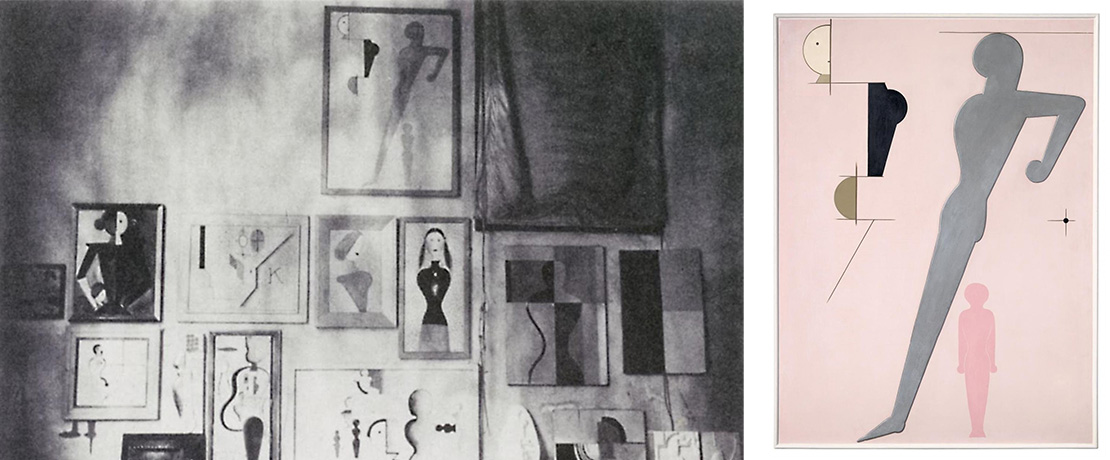
Oskar Schlemmer’s work is defined by the idea of a rationally thinking person in an ordered, modern world. Using geometrical and mathematical principles, he developed a human image freed from every emotion and gave expression to it in works along the threshold between painting and sculpture. The “Komposition auf Rosa”, the artist’s own reconstruction of a work created in 1916 (Baltimore Museum of Art), is a brilliant presentation of this vision.
For the “Komposition auf Rosa”, created in 1930 using metallic and enamel paints on canvas with a wood relief of a figure, Schlemmer produced the geometrically simplified shape of a figure that stretches along the diagonal of the picture plane and is flanked by two figural elements. As aptly described by Karin von Maur, the figure of a youth seems to be filled with a dynamic tension that stretches from the tips of his toes to his circular head, becoming balled up in the arc of the head and suggesting some kind of movement in the bent arm. Its oblique placement and pointed foot convey a sense of a labile, hovering state between standing and falling, which is countered by the small, pink figure at the bottom right (see von Maur, Oskar Schlemmer, München 1979, p. 76). The fragments of an additional figure inscribed into a linear framework in the upper left corner serve to balance the composition. Although it is kept nearly twodimensional, the composition’s various colours ranging from beige to pink and grey to black, their different qualities and the slightly raised relief of the main figure convey a sense of space. Through its exceptional position between architecture, relief and painting, “Komposition auf Rosa” embodies the universal idea of the Bauhaus better than almost any other work.
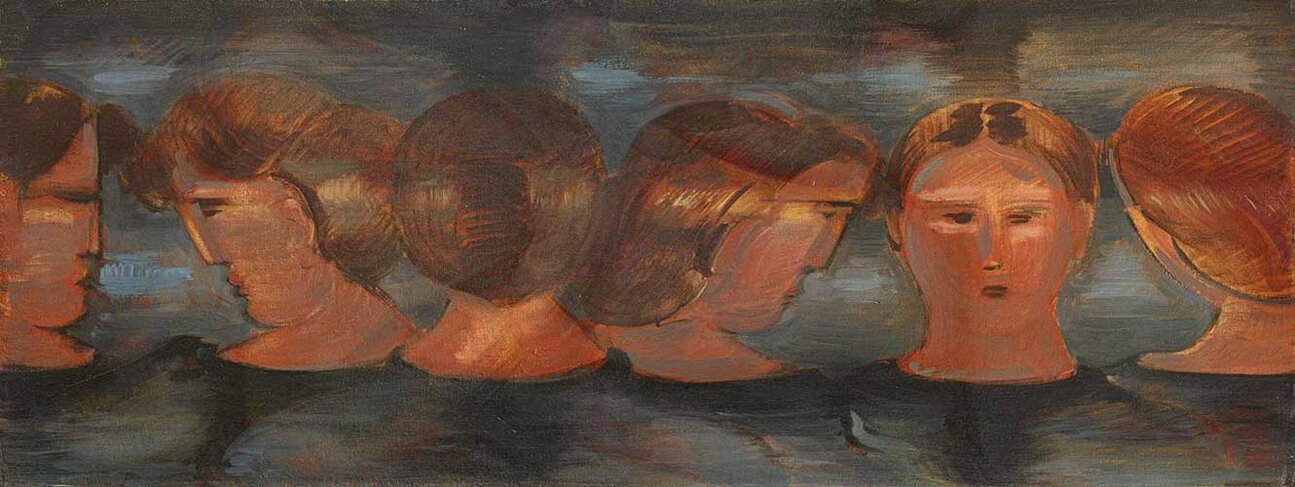
The “Sechs-Köpfe-Fries” is the only pure painting from Schlemmer’s estate to be offered for sale. Originally conceived as a vertical format, the work was created in 1930 in connection with Schlemmer’s most important commission to paint the circular room in the Museum Folkwang in Essen, at the center of which was the figurative fountain monument by George Minne (1905/1906). Oskar Schlemmer was a respected and sought-after artist in 1930 when he was commissioned by Ernst Gosebruch, the director of the Essen museum at the time, who was highly open-minded towards modernism, to decorate the Essen round room and thus prevailed over the designs by Willi Baumeister and Erich Heckel. Taking his cue from the six boy figures in the Minne Fountain, Schlemmer designed nine individual vertical panels depicting youthful figures in reduced colors and forms. As a design for one of these panels, he set the boys against an intense yellow background. As the conditions of the Essen commission changed several times and Schlemmer repeatedly submitted new designs, the painting ‘The Yellow Men’ – the working title – soon no longer had a function. When Schlemmer returned to paintings such as “Drei in der Halle” and “Unterhaltung” around 1935 after a long creative break, he took up the narrow portrait format of “Die gelben Männer” again, turned it into a landscape format and began to completely paint over the original depiction with a frieze of six girls’ heads. His pictorial language had now become more painterly, so that his heads, depicted alternately from behind, in profile and from the front, form a seemingly floating, moving garland. In keeping with his image of humanity, the heads of the girls are formally reduced and stripped of all characterization. In his diary on 15.2.1935, Schlemmer described the creative process in the following words: “There were incredible stages of overpainting, the intense yellow-orange ground shining through against new darknesses. Even now, after almost everything has been covered, the traces of what was underneath are still haunting. [...] There is a peculiar mood in the picture [...], a midnight, fluctuating, phosphorescent one. A moving, living thing.” (quoted from: Karin v. Maur, Oskar Schlemmer, Munich 1979, p. 110). As von Maur aptly describes it, the painting gains a completely new, heightened quality through the overpainting, in that the shading of the figures and the streak of light lend the frieze an enigmatic depth.
Further works from the Estate of Oskar Schlemmer can be found in the Auction 1269 - Day Sale - Modern Art.
Auction
Auction 1268 - Evening Sale – Modern Art
Auction
Friday 30 May
6 pm | Lot 1 – 77
Preview
Saturday 24 May | 10 am - 4 pm
Sunday 25 May | 11 am - 4 pm
Monday 26 May - Wednesday 28 May
10 am - 5.30 pm
Thursday 29 May | 11 am - 3 pm
Matinée
Saturday 24 May | 12 pm
Isabel Apiarius-Hanstein and Henrik Hanstein meet Sebastian Preuss
(Senior Editor WELTKUNST) for a discussion about the legacy of Oskar Schlemmer
________________________________________________
MUNICH
A selection
St.- Anna-Platz 3, 80538 Munich
Tuesday May 6 and Wednesday May 7,
10 am - 5 pm
________________________________________________
BRUSSELS
A selection
Grote Hertstraat 6, Rue du Grand Cerf, 1000 Brussels
Vernissage | Saturday April 26,
11 am - 5 pm
Sunday April 27, 11 am - 5 pm
Monday April 28 and Tuesday April 29,
10 am - 5.30 pm
________________________________________________
BERLIN
A selection
Poststr. 22, 10178 Berlin-Mitte
Vernissage | Monday May 12,
6 pm - 9 pm
Tuesday May 13 and Wednesday May 14,
10 am - 5 pm
Catalogue
Auction 1269 - Day Sale – Modern Art
Auction
Saturday 31 May
11 am | Lot 100 – 307
Preview
Saturday May 24 | 10 am - 4 pm
Sunday May 25 | 11 am - 4 pm
Monday May 26 - Wednesday May 28
10 am - 5.30 pm
Thursday May 29 | 11 am - 3 pm
Matinée
Saturday May 24th | 11 am
Sebastian Preuss meets Henrik Hanstein and Isabel Apiarius-Hanstein to talk about the legacy of Oskar Schlemmer
___________________________________________________
MUNICH
In selection A selection
St.-Anna-Platz 3, 80538 Munich
Tuesday, May 6 and Wednesday, May 7
10 am - 5 pm
____________________________________________________
BRUSSELS
A selection
Grote Hertstraat 6, Rue du Grand Cerf, 1000 Brussels
Vernissage
Saturday April 26 | 11 am - 5 pm
Sunday April 27 | 11 am - 5 pm
Monday April 28 and Tuesday April 29
10 am - 530 pm
_______________________________________________________
BERLIN
A selection
Poststr. 22, 10178 Berlin-Mitte
Vernissage Monday May 12 | 6 - 9 pm
Tuesday May 13 and Wednesday May 14
10 am - 5 pm
Catalogue