Jacob van Loo’s Venus and Adonis, c. 1655, and the Market for Old Masters on the Eve of the French Revolution
Jacob van Loo’s painting with its sensuous depiction of Venus and Adonis from the upcoming auction Old Masters and 19th-Century Art can be traced back to 1783, when it was sold at auction in Amsterdam. The catalogue of that sale has survived and offers a fascinating glimpse into the international auction market on the eve of the French Revolution.
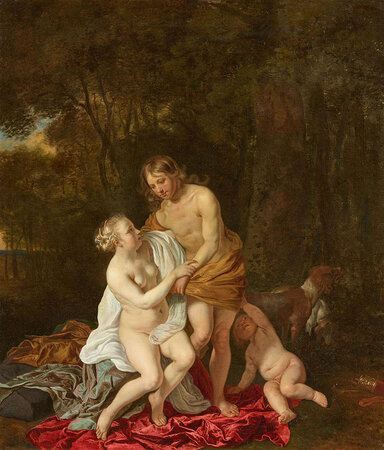
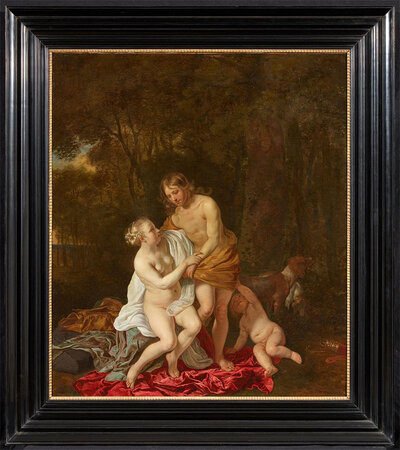
An Old Master painting entirely to the taste of collectors and dealers: a cabinet picture of medium format with an elegant figural composition depicting Venus and Adonis, the flesh tones of the figures of exceptional delicacy and the drapery of refined colouring. It is one of those mythological paintings for which Jacob van Loo was celebrated in the Dutch Golden Age, and a testament to the contemporary vogue for antique mythologies, Arcadian subjects, and southern landscapes that Amsterdam’s cultivated art audiences so eagerly embraced.
The painting was sold at auction in Amsterdam on 22 September 1783, as part of the estate of a certain Pieter Locquet. It is worth leafing through the catalogue of that sale, for it reflects the development of the international auction market at the time. To be precise, there were two catalogues: the commercially astute Dutch auctioneers published both a Dutch and a French version – the latter aimed at a new and evidently still inexperienced international clientele.
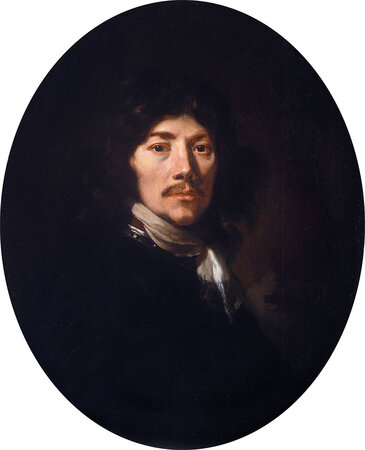
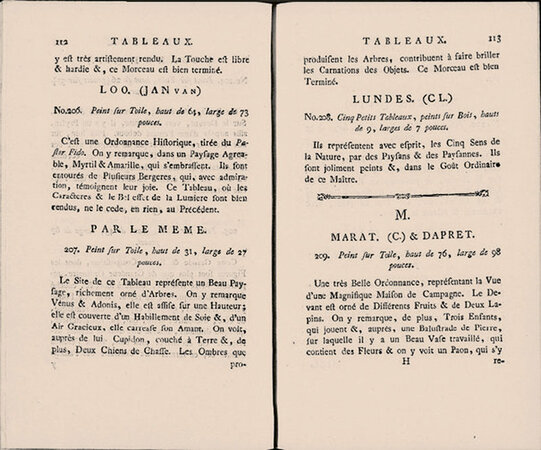
The Dutch version is plain and straightforward, opening directly with the lots to be sold, much like one of those art inventories so typical of the period. Jacob van Loo’s painting is listed tersely as Venus en Adonis in een Boomryk Landschap (Venus and Adonis in a Wooded Landscape). How very different the French version! There one finds an extended description:
The scene of this painting shows a beautiful landscape, richly adorned with trees. One recognises Venus & Adonis; she is seated on an elevation; she is draped in silk & a graceful, flowing garment; she caresses her Adonis. One also sees Cupid, lying on the ground &, beyond him, two hunting dogs. The shadows cast by the trees serve to illuminate the flesh tones of the figures.
(Le Site de ce Tableau rerpésente un Beau Paysage , richement orné d'Arbres. On y remarque Venus & Adonis, elle est assise sur une hauteur ; elle est couverte d'un habillement de Soie &, d'un Air Gracieux , elle carresse son Amant. On voit, auprès de lui Cupidon, couché a Terre & , de plus, Deux Chiens de Chasse. Les Ombres que proudisent les Arbres, contribuent à fiare briller les Carnations des Objets.)
The description ends with the observation: This piece is well executed (Ce Morceau est bien Terminé).
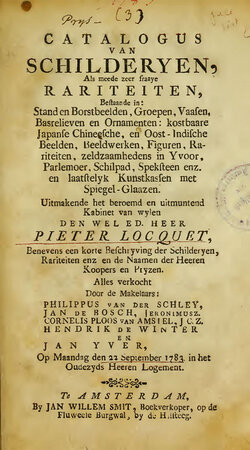
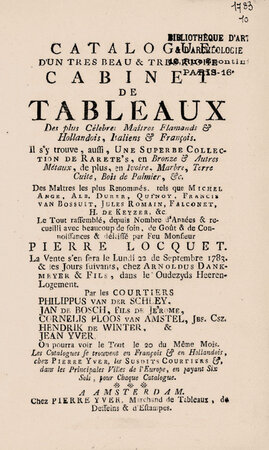
The catalogue entry captures the qualities of the work with remarkable precision and could today be reproduced almost unchanged. Yet the author of the French entry committed a rather glaring error: he got the artist’s first name wrong, rechristening him as Jan van Loo (in the Dutch version the first name is simply abbreviated) – a mistake that a present-day junior cataloguer ought not to make too frequently.
Such detailed picture descriptions in an auction catalogue were new – and unusual – for this period. So new and unusual, in fact, that the Amsterdam auctioneers felt compelled to justify them in a preface. There it is stated that they serve “solely for the full satisfaction of foreign buyers, who are not in a position to judge the merits of the paintings themselves” (pour la Satisfaction entiere des Etrangers, qui ne sont pas à porté d'en voir, par Eux-mêmes...). A further, more recent innovation in the catalogue is also explained in the preface: the listing of works in alphabetical order by the artists’ names, regardless of the art-historical significance of their creators.
The publication of the French catalogue responded to the development of the art market in the second half of the eighteenth century: the internationalisation of the auction trade and the boom in the market for Old Masters – works by Italian and Netherlandish artists of previous centuries. Across Europe, aristocratic and bourgeois collections were taking shape, and the auction rooms of Amsterdam, Paris, and Leipzig swarmed with dealers, collectors, and art agents in pursuit of outstanding works from bygone eras. The Netherlands, with their rich store of historic art, were – like Italy – an exporting country for such works. Ever innovative and attuned to commercial realities, the Amsterdam auctioneers adapted to the emergence of a new type of buyer – the interested but inexperienced international client – with the bilingual publication of their auction catalogue.
These new amateurs (in the finest French sense of the word) needed to be educated aesthetically and encouraged to buy, but also acquainted with the customs of the auction room: thus the Avertissement prefacing the introduction, much like today’s conditions of sale, draws the buyer’s attention to the fact that a buyer’s premium is to be paid in addition to the hammer price (“as is customary”). This note is absent from the Dutch version, perhaps because the Dutch had been accustomed to bidding for works of art at auction for well over 150 years.
Jacob van Loo’s Venus and Adonis was, according to the RKD, purchased by a certain Coclers, who may be identified with the Dutch artist Louis Bernard Coclers. He was forced to emigrate to France, which would explain how the work later came to light there. This closes a circle of sorts, for Jacob van Loo himself had fled to the French capital following a fatal altercation. There he founded a Netherlandish-French dynasty of artists, whose members were still active at the end of the eighteenth century, when this painting was sold at auction in Amsterdam.
Jacob van Loo
Venus and Adonis
Oil on canvas (relined). 79.7 x 68.5 cm.
Monogrammed lower left: J.V.…
Auction Old Masters and 19th-Century Art
Cologne | 21 May 2026
Auction Dates
Auction 1288 - Old Masters and 19th century, Part I
Auction
Thursday, 21 May 2026 | 11 am
Old Master Paintings | lots 1000 – 1064
Old Master Drawings | lots 1065 – 1087
19th Century | lots 1088 – 1124
Preview
Friday, 15 May | 10 am – 5.30 pm
Saturday, 16 May | 10 am – 4 pm
Sunday, 17 May | 11 am – 4 pm
Monday, 18 May | 10 am – 5.30 pm
Tuesday, 19 May | 10 am – 5.30 pm
Wednesday, 20 May | 10 am – 5.30 pm
INVITATION
For the matinée on Saturday, 16 May at 12 pm, we cordially invite you to a panel discussion:
Living with historical works of art – an option for the 21st century?
Dr. Ulrich Leben in conversation with Isabel Apiarius-Hanstein and Takuro Ito
_____________________________________________________
BRUSSELS (selection)
Wednesday, 22 April | Opening 5 pm – 9 pm
Thursday, 23 – Saturday, 25 April | 11 am – 5 pm
_____________________________________________________
MUNICH (selection)
Monday, 4 – Wednesday, 6 May | 10 am – 6 pm
Catalogue

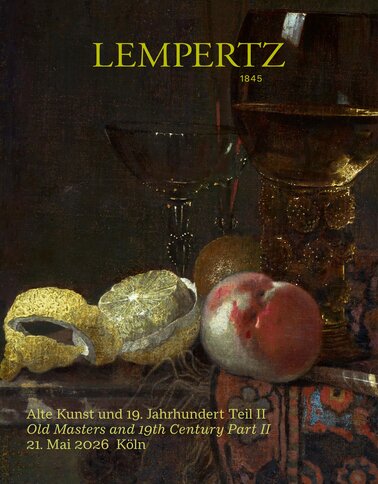
Auction 1288 - Old Masters and 19th century, Part II
Auction
Thursday 21 May 2026 | 2 pm
Old Master Paintings | Lot 1200–1266
19th Century Paintings | Lot 1267–1323
Preview
Friday 15 May | 10 am – 5:30 pm
Saturday 16 May | 10 am – 4 pm
Sunday 17 May | 11 am – 4 pm
Monday 18 May | 10 am – 5:30 pm
Tuesday 19 May | 10 am – 5:30 pm
Wednesday 20 May | 10 am – 5:30 pm
INVITATION
We cordially invite you to a matinée on Saturday, 16 May at 12 pm for a panel discussion:
“Living with Historical Works of Art – An Option for the 21st Century?”
Dr. Ulrich Leben in conversation with Isabel Apiarius-Hanstein and Takuro Ito
____________________________________________________
BRUSSELS (selection)
Wednesday 22 April | Opening 5 pm – 9 pm
Thursday 23 – Saturday 25 April | 11 am – 5 pm
____________________________________________________
MUNICH (selection)
Monday 4 – Wednesday 6 May | 10 am – 6 pm
Catalogue