

Art and Coast: Heckel’s Dangast Years Under the Sign of “Die Brücke”
Dangast – every summer between 1907 and 1920, Erich Heckel was drawn to this small coastal town, which at the time was becoming an ever more sought-after destination among tourists. Like many others seeking a brief escape from the confines of industrial-age cities, the young artist was attracted to the North Sea. For Heckel, it was not just the fresh air that appealed, but even more so the rustic scenes of rural life to be found here.
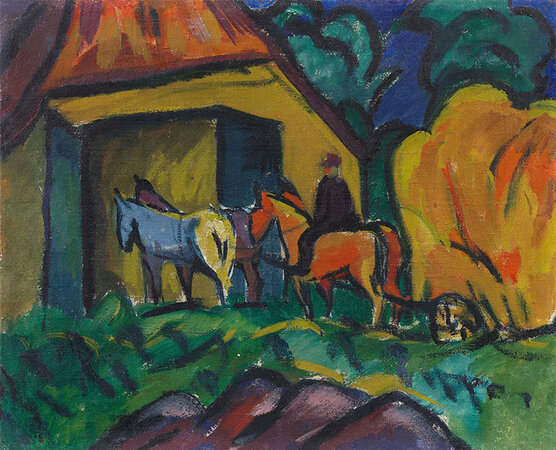
Dangast – every summer between 1907 and 1920, Erich Heckel was drawn to this small coastal town, which at the time was becoming an ever more sought-after destination among tourists. Like many others seeking a brief escape from the confines of industrial-age cities, the young artist was attracted to the North Sea. For Heckel, it was not just the fresh air that appealed, but even more so the rustic scenes of rural life to be found here.
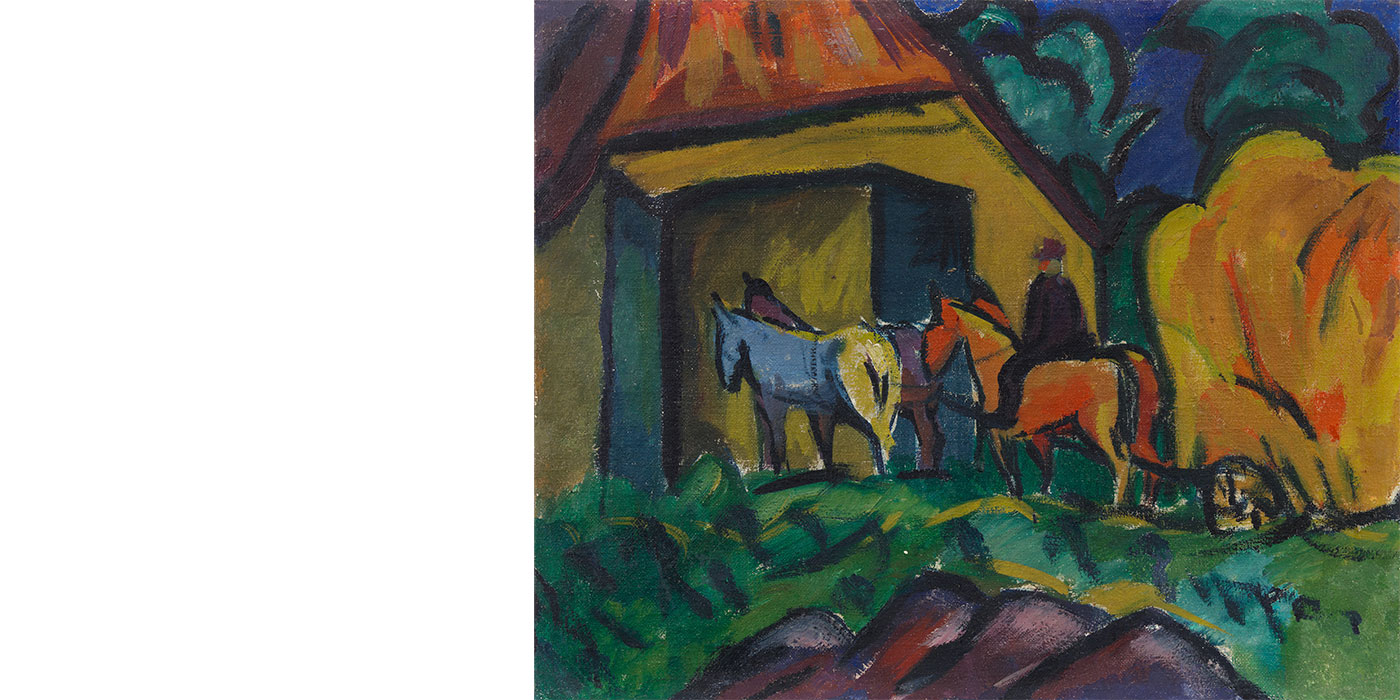
It must have been a sunny late summer’s day when Heckel observed farmers “Bringing in the Harvest” and transformed it into this compact, vividly coloured painting. The cart is heavily laden with crops, as is only possible at this time of year and in fine weather. It marks the peak of the agricultural cycle, symbolising nature, whose energy is gathered in the nourishing grain, as well as the reward for a whole year’s labour embodied in the harvest. The work is dated to the year 1909.
Like Erich Heckel, his artist friend Karl Schmidt-Rottluff also found inspiration in the surrounding area. Four years before “Bringing in the Harvest” was created, the two had founded the artists’ group Die Brücke together with Ernst Ludwig Kirchner and Fritz Bleyl.
As early as 1908, works by both artists were shown in an exhibition in Oldenburg, where contemporary critics gave a slight preference to Heckel’s works from this period. In retrospect, the collector Gustav Schiefler observed that the sea at Dangast had given Heckel a “sense of the vastness of space and the physicality of the air”.
In keeping with the Brücke style that was already taking shape by 1909, it is through areas of colour that Heckel expresses this feeling on canvas. This is evident in the expanse of the sea and, even more strikingly, in the idyllic scenes of rural coastal life, as seen in “Bringing in the Harvest”.
Auction Dates
Auction 1291 - Evening Sale - Contemporary Art
Auction
Friday 5 June
6 pm Lot 1 – 55
Preview
Saturday, May 30, 10 am – 4 pm
Sunday, May 31, 11 am – 4 pm
Thursday 4 June, 11 am – 4 pm
Matinée
Saturday, May 30, from 11 am
Dr. Daniel Zamani (Museum Frieder Burda) in conversation with
Isabel Apiarius-Hanstein on Yoshitomo Nara, at 12 PM
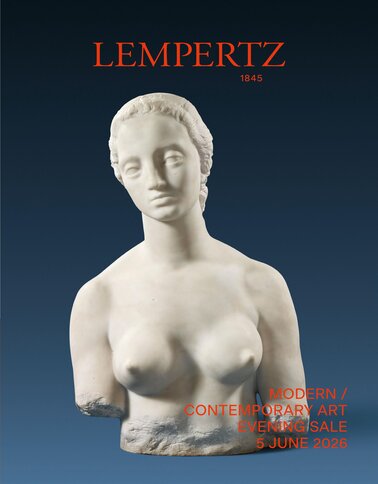
Introduction to the sculpture “Frauenbüste (Büste Frau L.)”
by Wilhelm Lehmbruck
_______________________________________________________
MUNICH
A selection
St.-Anna-Platz 3, 80538 Munich
Monday, May 4 – Wednesday, May 6, 10 am – 5 pm
_______________________________________________________
BERLIN
A selection
Poststr. 22, 10178 Berlin-Mitte
Monday, May 11 / Tuesday, May 12, 10 am – 5 pm
After-work reception
Monday, May 11, from 5 pm
Catalogue
Auction 1291 - Evening Sale - Modern Art
Auction
Friday 5 June
6 pm Lot 1 – 55
Preview
Saturday, May 30, 10 am – 4 pm
Sunday, May 31, 11 am – 4 pm
Thursday 4 June, 11 am – 4 pmt
Matinée
Saturday, May 30, from 11 am
Dr. Daniel Zamani (Museum Frieder Burda) in conversation with
Isabel Apiarius-Hanstein on Yoshitomo Nara, at 12 PM
Introduction to the sculpture “Frauenbüste (Büste Frau L.)”
by Wilhelm Lehmbruck
_______________________________________________________
MUNICH
A selection
St.-Anna-Platz 3, 80538 Munich
Monday, May 4 – Wednesday, May 6, 10 am – 5 pm
_______________________________________________________
BERLIN
A selection
Poststr. 22, 10178 Berlin-Mitte
Monday, May 11 / Tuesday, May 12, 10 am – 5 pm
After-work reception
Monday, May 11, from 5 pm
Catalogue